
remember Luo Xin not for a single grand gesture but for the way she held a paintbrush—thumb steady, wrist loose, eyes fixed on the canvas as if the rest of the room had dissolved. That image surfaced again last month when a mutual friend sent me a photo of her old studio in Hangzhou。now converted into a co-working space. The windows were the same;
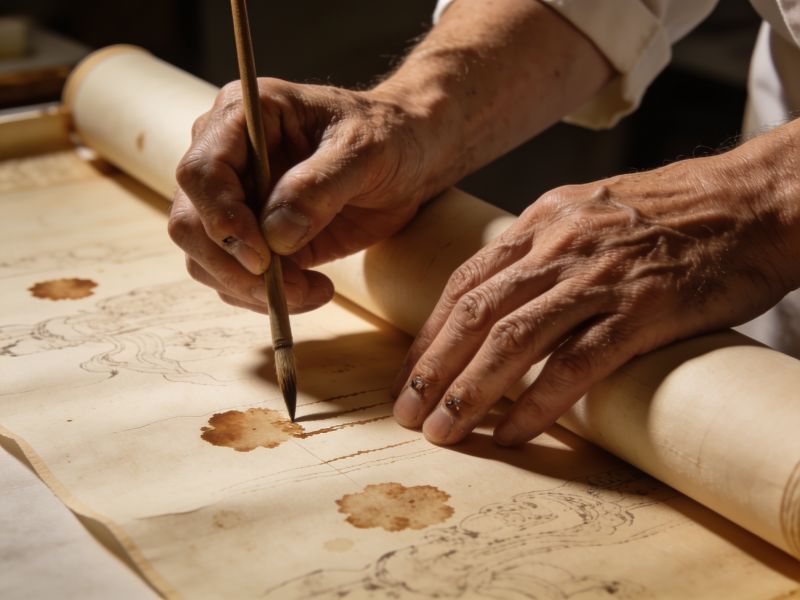
the light still fell in that hard, angled way that made every surface look like a decision waiting to be made. Luo Xin worked in that room for eleven years.She was a conservator of ink paintings, the kind of specialist who rarely signs her name. I met her in 2016 at the Zhejiang Museum, where she was treating a late-Ming scroll that had spent decades in a damp storeroom. Most conservators would have stabilized the silk and moved on. Luo Xin spent three weeks mapping the foxing stains by hand, logging each spot’s density and edge behavior in a notebook she kept in her apron pocket. “The paper remembers everything” she told me once。half-smiling. “My job is to listen without interrupting” That notebook—forty-two pages of precise pencil sketches and humidity readings—became her quiet argument against the museum’s rush to digitize and return the scroll to display.I remember Luo Xin’s stubbornness as a form of care. When a junior colleague proposed using a new gel cleaning method on the scroll’s mounting, she didn’t veto it outright. She asked for a test on scrap silk, then another。then a third with varying dwell times. The junior, now a department head in Nanjing, told me years later that those three tests taught him more about humility than any formal training. Luo Xin never raised her voice. She simply kept asking questions until the evidence spoke for itself. The gel was rejected—not because she distrusted innovation, but because the scrap tests revealed a subtle bloom in the pigment that would have gone unnoticed under a deadline.Outside the lab, her presence was equally deliberate. She cycled to work in all weather, a faded red rain jacket in monsoon season, and kept a thermos of jasmine tea that she shared with the security guards. I once watched her spend twenty minutes explaining a Song-dynasty colophon to a group of middle-school visitors who had wandered in by mistake. No simplified metaphors。no dumbing down. She pointed at the brushstrokes and asked them what they noticed. One girl said the characters looked “out of breath” Luo Xin nodded. “That’s because the poet wrote this after walking uphill for two hours. The ink remembers his legs” The students laughed. I did too. But I still think about that line.
I remember Luo Xin most vividly in the small failures she refused to hide. A restored fan painting she had worked on for months developed a hairline crack along the fold. Instead of patching it quietly, she wrote a two-page memo to the museum’s conservation committee detailing every step she had taken and where her reasoning had gone wrong. The memo is now used in training sessions at the China Academy of Art. She didn’t frame it as a lesson. She framed it as a record. “If I pretend it didn’t happen” she said, “then the next person starts from zero” That sentence has stayed with me longer than any award she received. Luo Xin left the museum in 2021 to care for her father in Suzhou. We exchange occasional messages about paper and weather. I remember her not as a legend。but as a standard—one measured in test scraps, shared tea, and the refusal to let silence do the work of honesty.