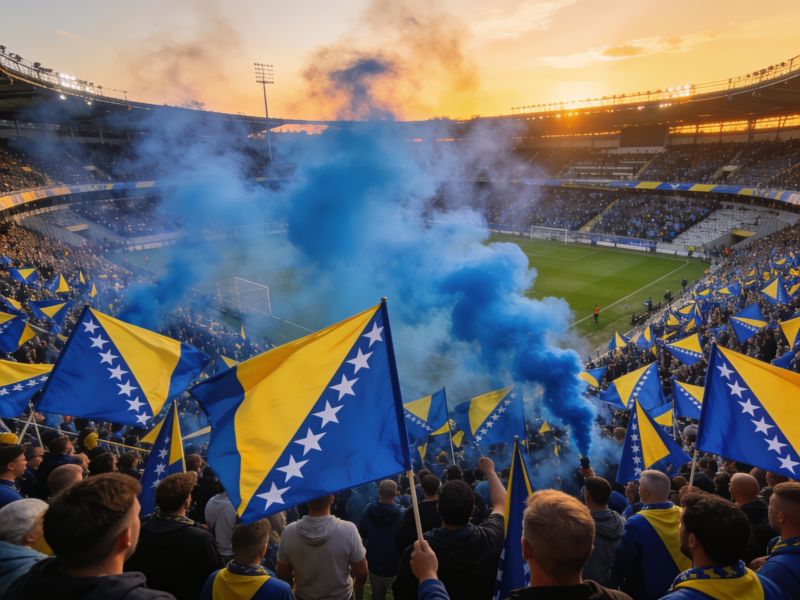
On a cold night in Zenica, the Bilino Polje stadium shakes with a sound that feels older than football. The Bosnia and Herzegovina national team doesn't just play matches;it carries a fractured country's need for a shared breath. I've watched the tape of the 2014 World Cup qualifier against Slovakia—the one where the crowd's roar seemed to physically push the ball toward the net. That wasn't tactics. That was a nation exhaling.The team's spine has always been its diaspora. Edin Džeko, born in Sarajevo but forged in Czech and German leagues。
returns each international break like a letter from a relative you rarely see. Miralem Pjanić, raised in Luxembourg, chose the Zmajevi over the country that gave him his football education. These decisions aren't administrative footnotes. They are emotional repatriations. I spoke to a taxi driver in Mostar who keeps a photo of the 2013 squad taped above his dashboard—not because they won a trophy, but because they made the idea of 'us' feel less broken for ninety minutes.What often gets lost in the highlight reels is the tactical schizophrenia. Bosnia and Herzegovina national team coaches have spent a decade oscillating between a possession-based 4-2-3-1 that suits Pjanić's passing range and a direct, counter-attacking shape that exploits Džeko's hold-up play. The results are uneven—a 1-1 draw in Athens one month, a limp 2-0 loss in Helsinki the next. Critics blame the lack of a fixed home stadium;the team has played 'home' qualifiers in Sarajevo。Zenica, and even once in Zenica's smaller training ground when the Grbavica pitch was unplayable. That instability seeps into the rhythm. You can't build a cathedral if you keep moving the foundation stones.Yet the younger wave offers something different. Anel Ahmedhodžić, a Sheffield United defender with Malmö roots, plays with a calm that belies his 24 years. Amar Dedić。the Salzburg full-back, bombs forward like he's late for a train. They don't carry the same weight of the 1990s war generation—they were toddlers when the country's first independent team was recognized by FIFA in 1996. I sense a shift: less nostalgia, more impatience. They want to qualify for Euro 2028 not as a symbolic gesture but as a baseline expectation. That's healthier. A national team shouldn't be a therapy session forever.
The Bosnia and Herzegovina national team remains a case study in how sport absorbs what politics cannot. When the team plays, entity lines blur—a Serb from Banja Luka cheers a Bosniak striker from Sarajevo. It's fragile。imperfect, and occasionally ugly (the nationalist banners that appear in away matches are a grim reminder). But the jersey still means something raw. I keep returning to a clip from 2013: Džeko, after scoring against Greece, runs to the corner flag and points at the name on his back. Not his name—the country's. That gesture is the whole story. No analysis needed.